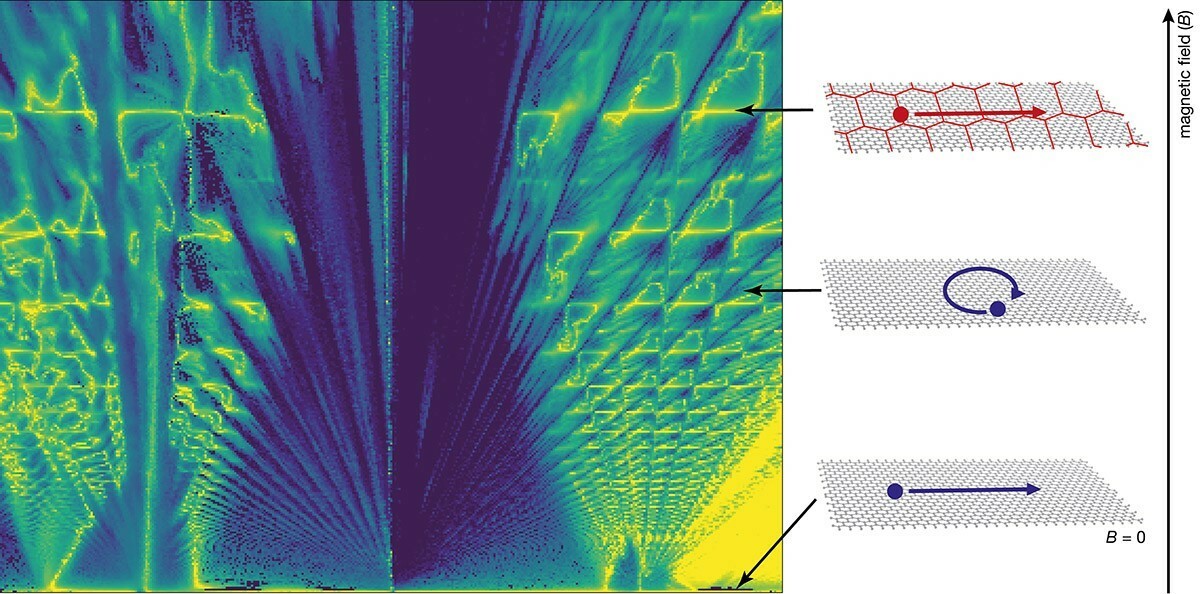
Moire superlattices represent one of the most exciting and unusual developments enabled by van der Waals materials. The first superlattice of this kind occurs when graphene is crystallographically aligned with hBN crystals. Due to an extremely small lattice mismatch between graphene and hBN (1.8%), such alignment produces additional spatial periodicity of approximately 14nm. This reduction in the size of the Brillouin zone dramatically modifies the electrical properties of graphene, creating additional neutrality points and, in some cases, producing flat bands, which reduce the Fermi velocity towards zero.
One of the most studied moire superlattices today is twisted bilayer graphene, where two graphene layers are rotated at a small angle relative to each other. The twist angle in such a structure acts as the knob, tuning the strength of the interlayer coupling and the length of the additional spatial periodicity. As the twist angle approaches 1 degree, all these factors result in flat bands, enabling the observation of strongly interacting phenomena such as superconductivity, orbital ferromagnetism, and other interaction effects in this system.
Currently, our group is exploring multilayer twisted materials with a focus on interlayer screening effects. This exploration has the potential to modify phenomena in such materials and enable many new functionalities.
One of the most studied moire superlattices today is twisted bilayer graphene, where two graphene layers are rotated at a small angle relative to each other. The twist angle in such a structure acts as the knob, tuning the strength of the interlayer coupling and the length of the additional spatial periodicity. As the twist angle approaches 1 degree, all these factors result in flat bands, enabling the observation of strongly interacting phenomena such as superconductivity, orbital ferromagnetism, and other interaction effects in this system.
Currently, our group is exploring multilayer twisted materials with a focus on interlayer screening effects. This exploration has the potential to modify phenomena in such materials and enable many new functionalities.
